Family is everything.
It sounds obvious, but you only truly understand it when life falls apart and you have nowhere else to turn.
I have learnt that family is not always the people you expect to be there. There are people I am related to whom I would not necessarily call family, and there are friends I would trust with my life.
I have had moments when I kept things from my family, convinced that friends would step in if things went wrong. I was wrong. When things eventually fell apart, it was family, sometimes upset that I had not asked for help sooner, who came through and pulled me out of some very dark places.
Perhaps I understood this because of how I grew up.
When I was a child, the community around us was an extension of the family. This was the era of “spare the rod and spoil the child”. If a neighbour caught you misbehaving, you could expect consequences before you even reached home.
I remember one neighbour catching my friends and me in some mischief. She gave me a proper beating, grabbed me by the ears and marched me home. My mother thanked her and continued the punishment.
I wanted to hate that neighbour. Looking back, I cannot.
There was something powerful about growing up knowing that other adults cared enough to correct you. Children belonged to the community. So did their problems.
Even an orphan was rarely left entirely alone. Extended family and neighbours stepped in. Perhaps we were not wealthier, but we had something many people seem to be losing today: a sense that someone else’s child was also our responsibility.
Then life changed.
In 2001, I lost my mother, one of the greatest losses of my life. With her went more than a parent. I lost a home, a sense of direction and the certainty of knowing where I belonged.
But family stepped in.
My elder sister Pamela became my mother for a couple of years, even though she had her own family to care for. She gave me shelter when I needed it most. Later, my sister Christine and other relatives opened their homes to me.
Then there was my elder brother Tim, who eventually helped restore what we now call home, a place to return to and a space that once again felt like ours.
That same year, when my future was uncertain, my uncle Wambete picked me up and drove me to a media school in Nairobi. He did not simply drop me at the gate. He made sure I was admitted.
Twenty-five years later, I am still in media.
A career that has shaped my life began with someone deciding that my uncertainty should not become my destiny.
Then there are the people who are not family by blood.
Dan and I met in media school in 2001. We became friends almost by accident. We can go months without speaking, yet when I need him, he shows up. No long explanations. No ceremony.
Just there.
Perhaps that is what I have come to understand about family as I have grown older. It is not perfect. Families argue. They disappoint each other. They frustrate each other. Sometimes they hurt one another deeply.
But there is often a thread that remains.
Memory. Responsibility. History. Love.
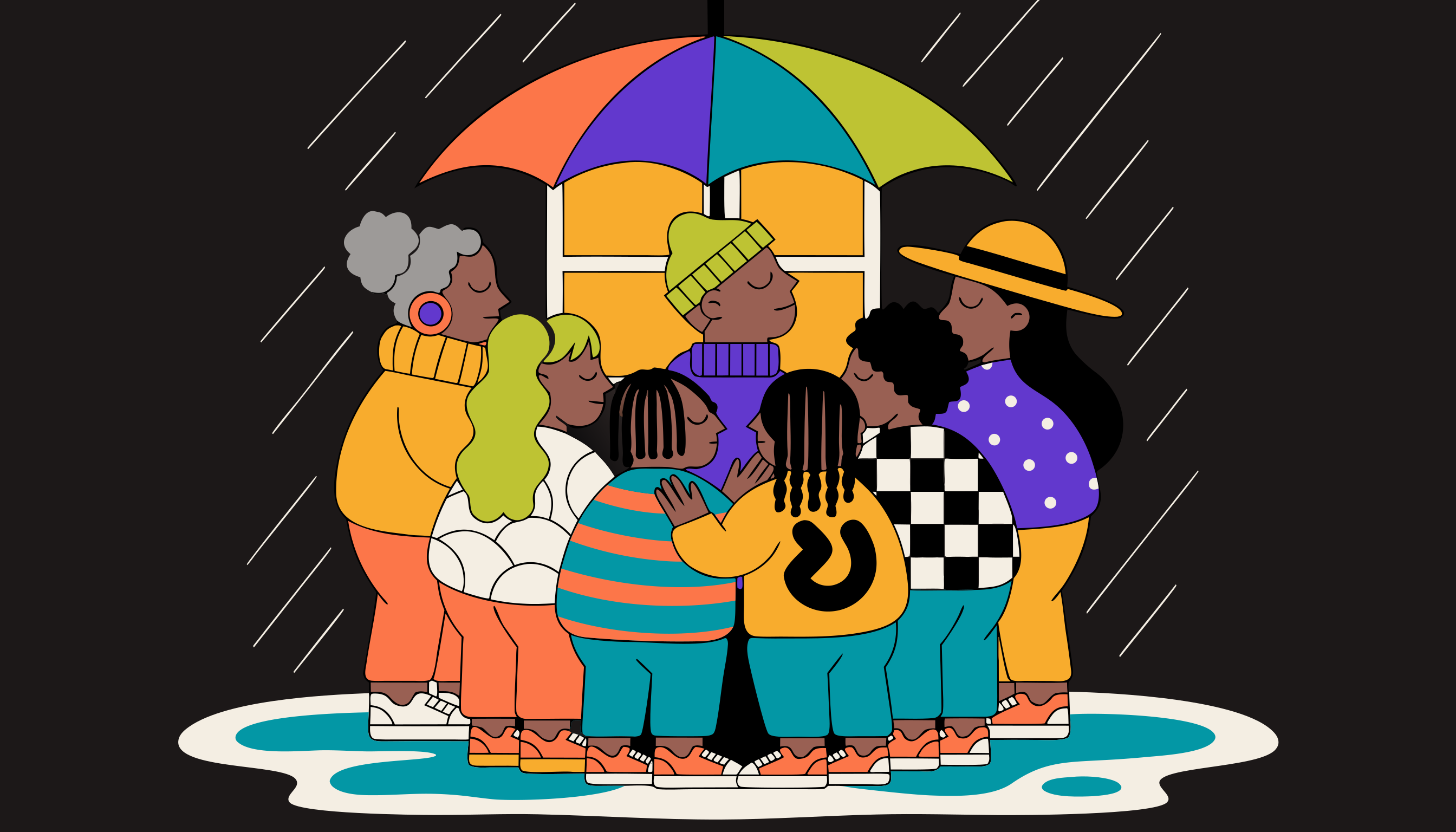
And sometimes, family is simply the people who refuse to let you face the storm alone.
We live in an increasingly individualistic world. We are connected to thousands of people online, yet many of us struggle to identify three people we could call at two in the morning when life goes wrong.
That should worry us.
Because sooner or later, all of us will need someone.
A job will disappear. A relationship will end. A business will fail. A dream will collapse. Grief will arrive without an invitation.
When that happens, who will you call?
And perhaps more importantly, whose call will you answer?
That is the real safety net.
Not the people who celebrate you when everything is going well, but the ones who show up when there is nothing to celebrate.
So, look around you.
Call that sibling. Check on that friend. Visit that uncle. Appreciate that mentor. Reconnect with the people who have quietly stood in your corner.
Because life has a way of reminding us that independence is useful, but nobody really makes it alone.
And when your turn comes to be someone's safety net, show up.
Sometimes, that is what family really means.