Dear Parent, now that the children are finally back in school, let us talk about the CBC holiday assignments and projects.
I know. You are still healing.
The Competency-Based Curriculum, or CBC, is, in my view, one of the better things to happen to our education system. It has its challenges, certainly, but many of those are systemic.
Since CBC came along, the relationship between parents and children has quietly changed. We are no longer simply paying school fees, checking report cards and asking whether homework is done. Sometimes, we are sitting beside them, figuring things out together. And strangely enough, that may not be such a bad thing.
This past holiday, my three children came home with three very different sets of assignments. If you have three children, you know what that means. Multiply the homework by three and add a generous dose of chaos.
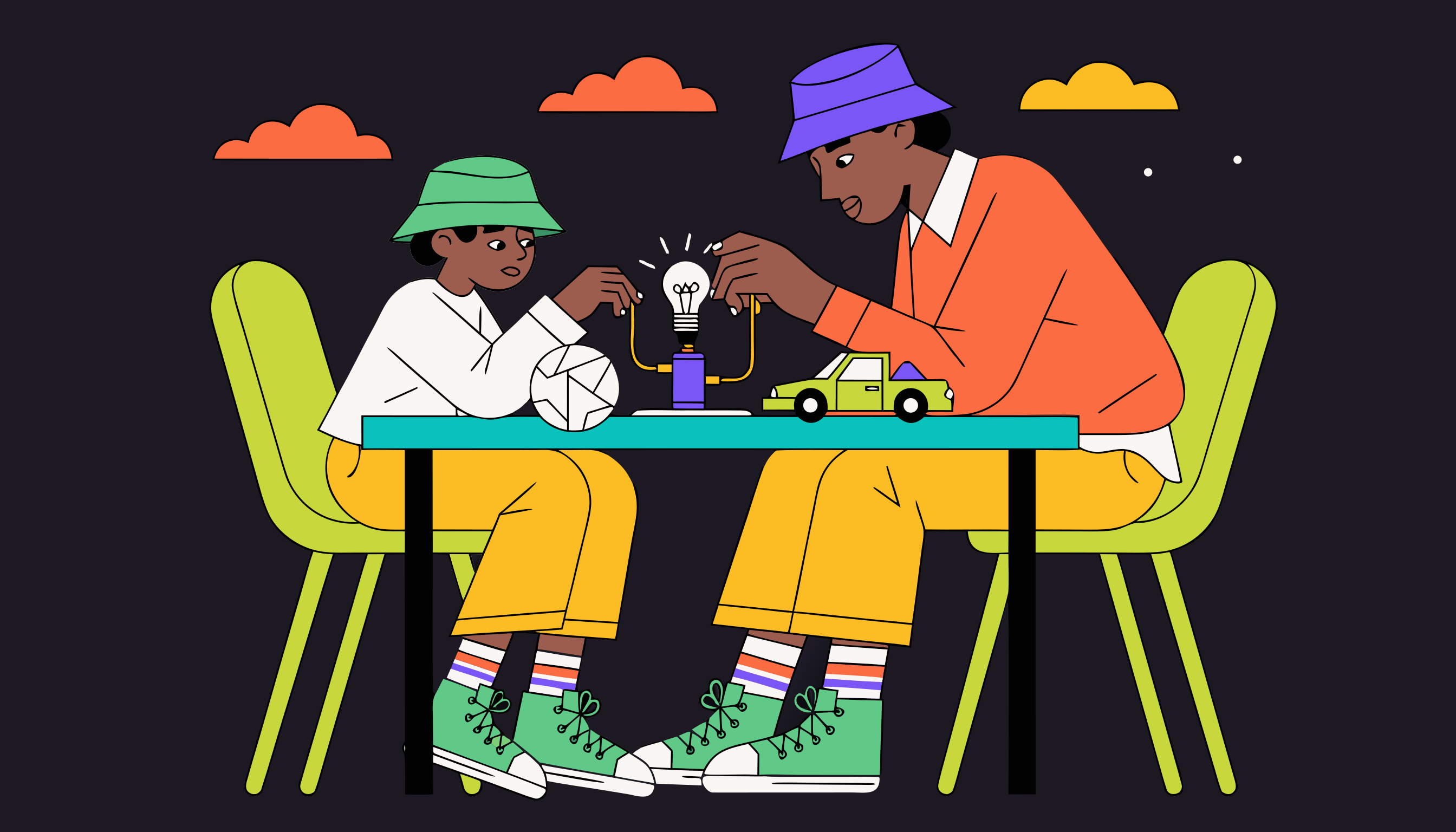
Nailantei had to make an electric circuit. Simple enough, I thought. So, naturally, I left it until the final week. Big mistake.
I bought dry cells, wires and a switch, confident that the bulb would be the easy part. Except the torch bulbs I grew up with seem to have disappeared. Everything I found was an LED or a solar bulb, and suddenly I was questioning my qualifications as a father.
After dismantling a torch, searching for a wooden board and consulting Tom, our estate electrician, we finally got it right. My bulb needed twelve volts, which meant connecting eight dry cells. When that little bulb finally lit up, so did my daughter's face.
Then came Naini's project, which took me straight back to childhood. We had to make a nylon paper football, the good old irifundo.
As I folded the paper, I remembered playing with my childhood friends Majanga and Aginga until the soles of our feet were red with dust. For a moment, I was that boy again. Then Naini and Nia started kicking their newly made ball around the house, and childhood returned in a completely different form.
There was also a toy car made from plastic materials and dried fruit seeds, followed by some tie and dye.
And that is where I think CBC gets something right.
These projects are not simply about passing an assignment. They teach children to make, fix, improvise and solve problems with what they have.
I learnt that lesson myself during the COVID-19 pandemic. Before then, I used to call an electrician almost every month to replace the element in my shower. Each visit cost me between KES 750 and KES 1,000. When movement restrictions made that difficult, I turned to YouTube.
The solution was embarrassingly simple. The element cost about KES 200.
Maybe that is what CBC is trying to teach. Not just children, but all of us. When something stops working, the first response does not always have to be, “Who can fix this for me?”
Sometimes it can be, “Let me see if I can figure it out.”
But perhaps the biggest lesson is not even the practical skill. It is the time we spend together.
These projects force parents into our children's world. They make us listen, explain, laugh, get frustrated and sometimes admit that our children know something we do not. In a world where we are constantly rushing, scrolling and working, that time is more valuable than we realise.
As my children returned to school, I found myself wondering who actually needed the holiday more: them or me.
The truth is, CBC may be giving parents homework too.
Our children are learning how to build circuits, make things from almost nothing and solve problems. We are learning patience and curiosity. We are discovering that raising children is not always about having the answers. Sometimes it is about sitting beside them and searching for the answer together.
So yes, dear parent, rest while you can. The next holiday project will come.
But when it does, do not see it only as another assignment that needs to be completed.
See it as homework for two.
Your child may be learning how to build something. You may be learning how to build a little more of the relationship between you.
And years from now, they may not remember the marks they got for that project. They might remember that you sat beside them and figured it out together.